
Basic Violet 2
- CAS
- 3248-91-7
- EC
- 2218317
- PubChem CID
- 14454445
- Molecular Formula
- C22H24ClN3
- Molecular Weight
- 365.9000 g/mol
Coloring agent in hair dyes. May cause allergic reactions and irritation on the skin; use is limited.
What does it do?
Used as a coloring agent in hair dye products.
Details
This is a synthetic dye providing dark purple and pink tones, used in hair dyes and some cosmetics. A chemical that emits a smoky scent over time, it causes redness and irritation by disrupting skin proteins upon contact. Products containing this ingredient carry a high risk of redness and itching for allergic skin types. A patch test must be performed before use.
Hazards

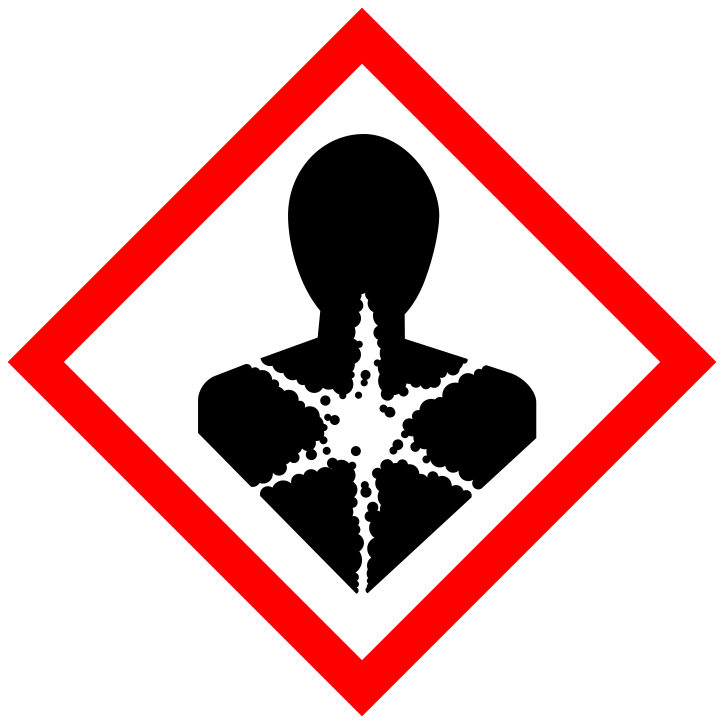
Benefits
Functions
Restrictions
Where is it found?
Function & Use
Hair Dyeing
Cosmetic Colorant
Regulatory note
- EU 1223/2009 Annex IIIRestricted
Maximum concentration: 0.5%
- EU 1223/2009 Annex IVAllowed
Industry GHS notices (PubChem)
These are industry self-reports to ECHA, not our regulatory assessment.
- H315(45.5%)- Causes skin irritation
- H318(56.9%)- Causes serious eye damage
- H319(39.8%)- Causes serious eye irritation
- H335(44.7%)- May cause respiratory irritation
- H350(12.2%)- May cause cancer
- H351(36.6%)- Suspected of causing cancer
- H373(31.7%)- May cause damage to organs through prolonged or repeated exposure
- H400(33.3%)- Very toxic to aquatic life
- H410(44.7%)- Very toxic to aquatic life with long lasting effects
What The Sources Say
SCCS (EU Scientific Committee on Consumer Safety)2
EU 1223/2009 Annex III — SCCS opinion: Opinion on Basic Violet 2
+1 more records.
ToxValDB (EPA Toxicity Value Database)8
EPA ToxValDB skin/eye data — endpoint: Eye Irritation, classification: Classification not possible. Caveat: this is an aggregated record; dose, species and route of exposure must be considered together.
EPA ToxValDB skin/eye data — endpoint: Skin Irritation, classification: Classification not possible. Caveat: this is an aggregated record; dose, species and route of exposure must be considered together.
EPA ToxValDB skin/eye data — endpoint: Skin Sensitization, classification: Classification not possible. Caveat: this is an aggregated record; dose, species and route of exposure must be considered together.
EPA ToxValDB skin/eye data — endpoint: Eye Irritation, classification: Category 6.4A (Category 2A). Caveat: this is an aggregated record; dose, species and route of exposure must be considered together.
EPA ToxValDB skin/eye data — endpoint: skin sensitisation, classification: Not likely to be sensitizing, species: guinea pig, study: skin sensitization, guideline: equivalent or similar to other guideline: As mentioned below, year: 2007. Caveat: this is an aggregated record; dose, species and route of exposure must be considered together.
+3 more records.
Scientific References
- EPA CompTox Chemicals Dashboard — DSSTox identifiers mapped to CAS (2021r1)US EPA, Center for Computational Toxicology and Exposure
- EU CosIng — Cosmetic Ingredient Database full exportEuropean Commission, DG GROW
- Opinion on Basic Violet 2SCCS — Scientific Committee on Consumer Safety
- ToxValDB — genotoxicityUS EPA — ToxValDB v97
- ToxValDB — skin/eyeUS EPA — ToxValDB v97