
4-Nitro-o-Phenylenediamine
- CAS
- 99-56-9
- EC
- 2027663
- PubChem CID
- 5111791
- Molecular Formula
- C6H7N3O2
- Molecular Weight
- 153.1400 g/mol
Colorant in hair dyes. May cause skin allergy and irritation; use is restricted.
What does it do?
Used as a colorant in hair dyes.
Details
A synthetic dye used as a colorant in hair dyes. This substance, which provides a yellowish-orange color, may cause irritation and allergic reactions upon skin contact. This is related to the nitro group binding to skin proteins and triggering the immune system. Those with allergies and sensitive skin should use it with caution. It may appear on labels as a 'PPD derivative' or simply 'diamine'.
Hazards

Benefits
Functions
Where is it found?
Also known as
Function & Use
Hair Dyeing
Regulatory note
- EU 1223/2009 Annex IIIRestricted
Industry GHS notices (PubChem)
These are industry self-reports to ECHA, not our regulatory assessment.
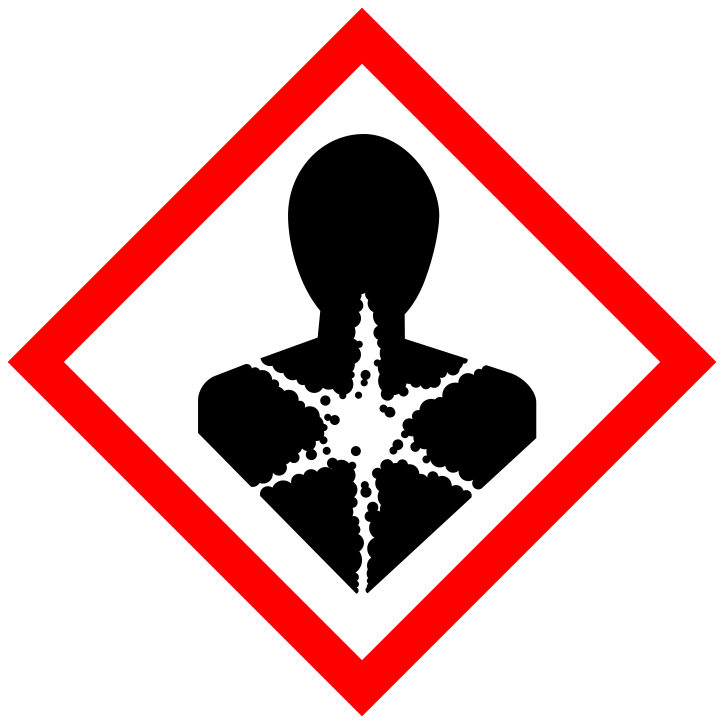
- H302(100.0%)- Harmful if swallowed
- H317(89.5%)- May cause an allergic skin reaction
What The Sources Say
CIR (Cosmetic Ingredient Review)35
In ocular irritation studies with 4-Nitro-o-Phenylenediamine, the test material was slightly irritating to rabbit eyes when tested at 2.5 and 5%.2 RISK ASSESSMENT Margin of exposure (MOE) is a quantitative factor calculated for cosmetic ingredients by dividing the NOAEL obtained for an ingredient in an animal experiment by the estimated systemic exposure dose (SED) for the ingredient in humans, generally according to US Environmental Protection Agency (EPA) and European Commission SCCS guidelines. The standard MOE value of 100 is derived from multiplying two factors: a 10-fold factor extrapolating data from test animals to human being (interspecies extrapolation) and an additional 10-fold for differences among the human population (intra-species extrapolation). An MOE value greater than 100 has traditionally been considered an indication of safety. The MOE is sometimes referred to as margin of safety (MOS), despite the parameters being definitionally different. The SCCP calculated an MOE value for 0.5% 4-Nitro-o-Phenylenediamine in an oxidative formulation to be 357.6 This calculation is based on the NOAEL of 15 mg/kg bw/d (a 90-d oral rat study) and an SED of 0.042 mg/kg bw (skin area surface of 700 cm2 x absorption through skin of 3.6 µg/cm2 x 0.001 (unit conversion)/typical human bw of 60 kg). NOAEL 15 mg/kg bw/d MOE = = = 357 SED 0.042 mg/kg bw/d Distributed for Comment Only -- Do Not Cite or Quote HAIR DYE EPIDEMIOLOGY Hair dyes may be broadly grouped into oxidative (permanent) and direct (temporary or semi-permanent) dyes. The … [kırpıldı — bölüm toplam 2637 karakter]
Definition and Structure 4-Nitro-o-Phenylenediamine (CAS No. 99-56-9) is the substituted aromatic amine that conforms to the structure in Figure 1:CIR Staff,1 Figure 1. 4-Nitro-o-Phenylenediamine This ingredient is used both as a semi-permanent and a permanent hair dye.2 Chemical Properties Chemical properties are summarized in Table 1. 4-Nitro-o-Phenylenediamine is reported to be a red to orange-brown powder with a molecular weight of 153.14 g/mol.2,3 The estimated log Kow is 0.88.7 Distributed for Comment Only -- Do Not Cite or Quote Method of Manufacture 4-Nitro-o-Phenylenediamine is prepared by the reduction of 2,4-dinitroaniline using hydrogen sulfide in ammonia water.2 Impurities 4-Nitro-o-Phenylenediamine has a minimum purity of 98%.2 It may contain a maximum of 150 ppm iron. USE Cosmetic The safety of the cosmetic ingredient addressed in this assessment is evaluated based on data received from the US Food and Drug Administration (FDA) and the cosmetics industry on the expected use of 4-Nitro-o-Phenylenediamine in cosmetics. Data included herein were obtained from the FDA and in response to a survey of maximum use concentrations conducted by the Personal Care Products Council (Council), and it is these values that define the present practices of use and concentration. Frequencies of use obtained from the FDA include data from the Voluntary Cosmetic Registration Program (VCRP) database as well as Registration and Listing Data (RLD). As a result of the Modernization of Cosmetics Regulation Act (MoCRA) of 2022, the VCRP was discontinued in 2023 and, as of 2024, manufacturers and processors are required to … [kırpıldı — bölüm toplam 7132 karakter]
Dermal Penetration An in vitro and an animal study for 4-Nitro-o-Phenylenediamine are summarized in Table 3. The total absorbed dose following a 24-h exposure to [U-14C]-4-Nitro-o-Phenylediamine (dihydrochloride; 0.2 - 0.29% final on-skin) from 2 hair dye formulations tested using split-thickness pig skin was 0.83 ± 0.69 and 0.39 ± 0.24 μg eq/cm2.6 In rats that received 0.6% 3H- 4-Nitro-o-Phenylenediamine diluted with water on shaved skin for 20 min, 1.8% (2.2 µg/cm2) of the amount applied penetrated the skin and was recovered in the urine, feces, and carcass. The highest absorbed dose observed was equivalent to 3.6 µg eq/cm². Absorption, Distribution, Metabolism, and Excretion (ADME) Animal Oral A semi-permanent hair dye and base composite containing 4-Nitro-o-Phenylenediamine were administered orally to rabbits (97.5 mg/kg/d) and given in feed to rats (7800 ppm) and dogs (97.5 mg/kg/d); the animals excreted blue-brown urine.2 No further details were available. Animal oral ADME studies are summarized in Table 3. In rats that received a single gavage dose of 45 mg/kg bw C-4-Nitro-o-Phenylenediamine (dihydrochloride) in 1% carboxymethylcellulose, ~65% of the administered dose was 14 absorbed, based on urinary output.6 The test material or the radiolabeled metabolites were widely distributed throughout the body following absorption. 4-Nitro-o-Phenylenediamine was mostly converted into the conjugates N-acetyl-4-nitro-o- phenylenediamine and N-acetyl-actetylcysteine-4-nitro-o-phenylenediamine.
Acute Toxicity Studies Dermal Groups of 4 to 8 rabbits received 4-Nitro-o-Phenylenediamine in 10 ml of a permanent hair dye base topically on shaved skin (area not reported) for 24 h.2 No deaths were observed at doses of 5 g/kg 4-Nitro-o-Phenylenediamine. No further details were available. Oral In rats, the acute oral LD50 for 4-Nitro-o-Phenylenediamine ranged from 681 to 3720 mg/kg.2 Parenteral In rats, the acute intraperitoneal LD50 for 4-Nitro-o-Phenylenediamine was greater than 1600 mg/kg.2 Short-Term Toxicity Studies Dermal Hair dye composites containing 0.013 or 0.036% 4-Nitro-o-Phenylenediamine were applied topically (1 and 4 g/kg/d) under oxidative conditions to rabbits daily for 20 d.2 There were no signs of toxicity and no significant gross abnormalities at necropsy 14 d after the test period. There were local skin reactions during the test period, but the hair and skin appeared normal by the end of the 14-d observation period following the test period. Oral Mice that were fed up to 21,500 ppm 4-Nitro-o-Phenylenediamine in their diet for 7 wk were observed with orange- colored fur, while rats that were fed up to 10,000 ppm had arched back and rough coats.2 There were no adverse effects when a semi-permanent hair-coloring composite containing 0.16% 4-Nitro-o-Phenylenediamine was fed at a concentration of 7800 ppm for more than 8 wk to rats. (No further details available.) Parenteral Rats that received intraperitoneal doses of 100 mg/kg/d 4-Nitro-o-Phenylenediamine for 5 d or 20 mg/kg/d 4-Nitro-o- Phenylenediamine 3 times/wk for 8 wk had suppressed body weight gains.2 Distributed for Comment Only -- Do Not Cite or Quote Subchronic Toxicity Studies Dermal A hair dye composite containing 0.25% 4-Nitro-o-Phenylenediamine was applied to the hair and skin of rabbits once … [kırpıldı — bölüm toplam 5923 karakter]
Dermal Local skin reactions, but no other adverse effects, were observed in a 3-generation study of hair dyes containing 0.25% 4-Nitro-o-Phenylenediamine; the dyes were applied topically in doses of 0.5 ml 2 times/wk to mice.2 A hair dye formulation containing 0.25% 4-Nitro-o-Phenylenediamine was applied topically in a dose of 0.05 ml 2 times/wk to female mice prior to mating and throughout mating and gestation. There was no evidence of a teratogenic effect, but there may have been a delaying effect on the ossification process, particularly of the bones of the feet and of the cervical and caudal vertebral centra. Topical application of hair dyes containing 0.25% 4-Nitro-o-Phenylenediamine every third day during the gestation period of rats did not result in any signs of toxicity to the maternal or fetal animals. A hair dye composite containing 0.25% 4-Nitro-o-Phenylenediamine applied topically in a 2-generation rat study yielded no signs of toxicity. Oral There were no adverse effects when a semi-permanent hair-coloring composite containing 0.16% 4-Nitro-o- Phenylenediamine was fed at a concentration of 7800 ppm to male or female rats prior to or during mating, or to pregnant rats on days 6 - 15 of gestation.2 No embryotoxicity or teratogenic effects were observed. Up to 97.5 mg/kg/d oral dose of Distributed for Comment Only -- Do Not Cite or Quote this composite was administered to pregnant rabbits on days 6 - 18 of gestation; no signs of toxicity were observed to the maternal or fetal rabbits. Parenteral Doses of 4-Nitro-o-Phenylenediamine > 256 mg/kg/d, given to mice subcutaneously on days 6 - 15 of gestation, resulted in a significant decrease in maternal weight gain.2 At doses > 256 mg/kg/d, the number of fetuses with cleft palates and blood vessel malformations were significantly increased , and the average fetal weight was decreased. In another study, 4- … [kırpıldı — bölüm toplam 2191 karakter]
+30 more records.
IARC (International Agency for Research on Cancer)1
IARC Group 3 — Not classifiable as to carcinogenicity. The available evidence is insufficient for a classification. This does NOT mean 'safe'; it means 'not enough data'. (Monograph volume: 16, Sup 7). Caveat: IARC classifies HAZARD, not RISK — it says 'can cause cancer under some conditions', not 'causes cancer at cosmetic use levels'. Route and dose must be assessed separately. Data is a 01/2021 snapshot.
ToxValDB (EPA Toxicity Value Database)3
EPA ToxValDB skin/eye data — endpoint: Skin Sensitization, classification: SkinSens1. Caveat: this is an aggregated record; dose, species and route of exposure must be considered together.
EPA ToxValDB kanser değerlendirmesi: 3 - Not classifiable as to its carcinogenicity to humans. Caveat: this is an aggregated record; dose, species and route of exposure must be considered together.
EPA ToxValDB genotoxicity: positive — positive reports: 14, negative: 7, Ames: positive, micronucleus: negative. Caveat: this is an aggregated record; dose, species and route of exposure must be considered together.
Scientific References
- CIR — Amended Safety Assessment ofCosmetic Ingredient Review (CIR), Personal Care Products Council(2024)
- CIR — Amended Safety Assessment of 2-Nitro-p-PhenylenediamineCosmetic Ingredient Review (CIR), Personal Care Products Council(2025)
- EPA CompTox Chemicals Dashboard — DSSTox identifiers mapped to CAS (2021r1)US EPA, Center for Computational Toxicology and Exposure
- EU CosIng — Cosmetic Ingredient Database full exportEuropean Commission, DG GROW
- IARC Monographs — 4-Nitro-1,2-phenylenediamine (Group 3 — Not classifiable as to carcinogenicity)IARC — WHO Uluslararası Kanser Araştırmaları Ajansı
- ToxValDB — cancerUS EPA — ToxValDB v97
- ToxValDB — genotoxicityUS EPA — ToxValDB v97
- ToxValDB — skin/eyeUS EPA — ToxValDB v97