
Toluen
Toluene
- CAS
- 108-88-3
- EC
- 2036259
Ojede çözücü olarak kullanılır. Sinir sistemine ve solunum yollarına zarar verebilir; AB tarafından tırnak ürünlerinde %25 ile sınırlandırılmıştır.
Ne işe yarar?
Oje ve tırnak ürünlerinde çözücü olarak kullanılır.
Ayrıntı
Petrolden elde edilen bir çözücüdür, özellikle oje ve tırnak ürünlerinde kullanılır. Uçucu olduğu için solunduğunda baş ağrısı, baş dönmesi yapabilir; uzun süreli maruziyet sinir sistemine kalıcı hasar verebilir. Avrupa Birliği, tırnak ürünlerinde maksimum %25 oranında kullanımına izin verir. İyi havalandırılan ortamlarda kullanılması önerilir.
Zararlar
Faydalar
İşlevler
Kısıtlar
Nerede bulunur?
Ayrıca bilinir
Fonksiyon ve Kullanım
Antioksidan
Çözücü
Düzenleyici not
Avrupa Komisyonu, bu maddeyi 1223/2009 sayılı AB Kozmetik Ürünleri Yönetmeliği'nin Ek III'ünde (belirtilen sınırlamalara tabi olarak kozmetik ürünlerde bulunmaması gereken maddeler) referans numarası 185 altında listelemiştir. Konsantrasyon limitleri ve kullanım koşulları geçerlidir. Tanımlayıcılar: CAS 108-88-3, EC 203-625-9. Ek sütunlarında belirtilen ürün türleri ve maksimum konsantrasyonlar: Tırnak ürünleri — %25'e kadar.
- EU 1223/2009 Annex IIIKısıtlı
Maksimum konsantrasyon: 25%
Sanayi GHS bildirimleri (PubChem)
Bunlar ECHA’ya sanayi beyanlarıdır; bizim düzenleyici değerlendirmemiz değildir.
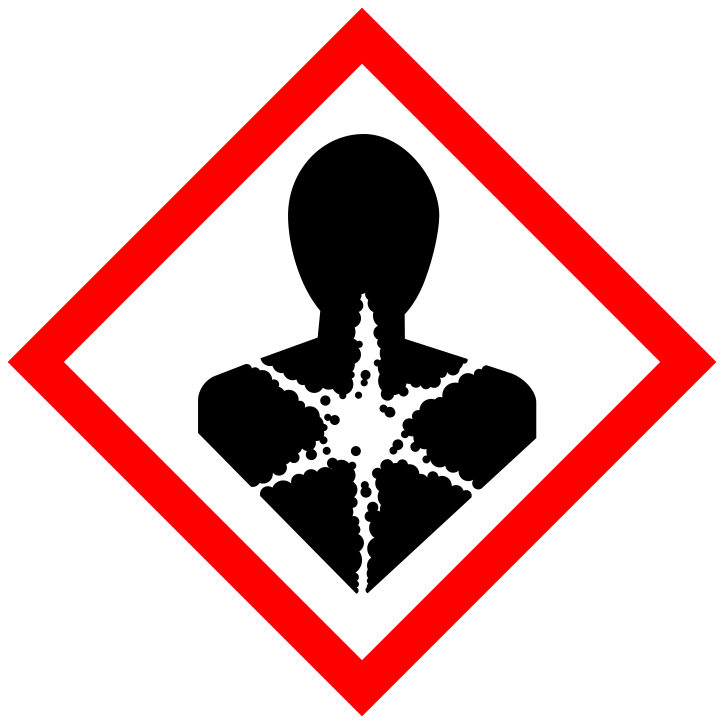
- H225(100.0%)- Kolay alevlenir sıvı ve buhar
- H303- H303
- H304(100.0%)- Solunum yoluna nüfuzu hâlinde öldürücü olabilir
- H315(100.0%)- Cilt tahrişine yol açar
- H320- Göz tahrişine yol açar
- H332- Solunması hâlinde zararlı
- H335- Solunum yolu tahrişine yol açabilir
- H336(100.0%)- Rehavet veya baş dönmesine yol açabilir
- H360- Doğmamış çocukta hasara ya da üreme yeteneğinde bozulmaya yol açabilir
- H361(100.0%)- Doğmamış çocukta hasara ya da üreme yeteneğinde bozulmaya yol açma şüphesi var
- H362- Emzirilen çocuğa zarar verebilir
- H370- Organlarda hasara yol açar
- H373(100.0%)- Uzun süreli veya tekrarlı maruz kalmada organlarda hasara yol açabilir
- H401- Sucul ortamda toksik
- H412(16.5%)- Sucul ortamda uzun süre kalıcı, zararlı
Kaynaklar Ne Diyor
SCCS (AB Tüketici Güvenliği Bilimsel Komitesi)2
EU 1223/2009 Annex III — SCCS görüşü: Opinion on Toluene (its use as a solvent in nail cosmetics)
+1 kayıt daha.
CIR (Kozmetik Madde İnceleme Paneli)20
Teratogenicity and embryotoxicity of Toluene were assessed in hamsters, mice, and rats via various routes of exposure (dermal, oral, inhalation).2 Minimal embryotoxic effects were observed in a dermal assay in which Toluene (concentration not stated) was applied to the clipped skin of hamsters on days 7 - 11 of gestation. Toluene was teratogenic at 1.0 ml/kg and embryotoxic at 0.3 ml/kg in mice given Toluene via gavage on days 12 – 15 of gestation. No significant reproductive toxicity was observed in an assay in which Toluene in corn oil (10 ml/kg bw) was given to pregnant mice for 8 d (GD not stated). Rudimentary 14th ribs were observed in female mice exposed to Toluene (1000 ppm) via inhalation on GD 1 - 17. Adverse effects in fetuses, such as low weight (observed in pregnant mice treated with 133 ppm Toluene on GD 6 - 13) and skeletal abnormalities (observed in pregnant rats treated with 266 -399 ppm Toluene on days 1 - 8 or 9 – 14 of gestation), were observed. Toluene was not teratogenic in fetuses of rats exposed to up to 400 ppm Toluene vapor on days 6 - 15 of gestation or in fetuses of rats exposed to 266 ppm Toluene on days 7 – 14 of gestation. A no-observed-adverse-effect-level (NOAEL) for embryotoxicity was determined to be 1.46 µmol/ml in an assay in which embryos were exposed to Toluene.3 Toluene (8.67 µg/ml) in a culture medium decreased sperm motility, inhibited in vitro fertilization, and increased preimplantation embryo degeneration. Decreased maternal weight gain and generalized growth retardation of fetuses was observed in assays in which dams were given Toluene via gavage (520 - 650 mg/kg bw; GD 6 - 19; in corn oil). Increased occurrence of pups with low birth weights and adverse effects relating to behavioral tasks in offspring were observed in an assay performed in rats and hamsters given 800 mg/m3 Toluene via inhalation (6 h/d … [kırpıldı — bölüm toplam 8480 karakter]
Acute Toxicity Studies The acute dermal median lethal dose (LD50) of Toluene in rabbits was determined to be 14.1 ml/kg.2 No deaths were observed in an acute percutaneous assay in which guinea pigs were dosed with 1.732 g/kg Toluene. Acute oral LD50s of Toluene in rats ranged from 2.6 g/kg to 7.53 g/kg. No toxic effects were observed in studies performed in rats given nail products containing 33 - 33.2% Toluene via gavage. Acute inhalation LD50s were determined to be 5320 ppm and 6942 ppm in two studies performed in mice (6 - 7-h exposure period). Acute inhalation studies performed in mice, rats, guinea pigs, rabbits, and dogs resulted in adverse effects including mucous membrane irritation, motor incoordination, prostration, changes in respiratory rate, changes in blood serum and enzymes, elevated blood glucose and packed cell volume, decreased body weight, and death. Effects varied according to animal species, length of exposure, and concentration of Toluene administered. Mortality was prevalent in several acute subcutaneous, intraperitoneal, and intravenous studies performed in mice, rats, guinea pigs, and rabbits (animals given 0.17 – 8.7 g/kg Toluene). Short-Term Toxicity Studies Progressive symptoms were observed in several species of animals following short-term inhalation of increasingly higher concentrations of Toluene (1 – 12,000 ppm) including irritation of mucous membranes, incoordination, mydriasis, narcosis, tremors, prostration, anesthesia, and death. In a study in which rats were given Toluene (1 ml/kg/d) via subcutaneous injection for 21 d, adverse effects were observed (e.g., decreased body weight, decrease in erythrocyte and leukocyte counts, focal hepatic necrosis).2 Similarly, adverse effects (polypnea, necrosis at injection sites, hemorrhagic, hyperemic, and degenerative changes in lungs, kidneys, adrenal glands, and spleen) were observed in guinea pigs given … [kırpıldı — bölüm toplam 4235 karakter]
Case Reports Non-Occupational A 22-yr-old man experience extensive chemical burns, acute renal failure, and disseminated intravascular coagulation, that eventually led to death, after spilling a sealer containing 65% Toluene on his clothing.3 A 60-yr-old man who consistently worked with glue containing 90% Toluene was admitted to the hospital with astenia and weight loss of 6 mo duration. Abnormalities upon diagnostic testing were found (e.g., cortical atrophy). Symptoms subsided following suspension of work. A 65-yr-old male farmer with previously diagnosed arterial hypertension presented to the hospital following accidental consumption of approximately 150 ml of an organic solvent.90 Initial symptoms post-consumption included tiredness, confusion, weakness, drunken-like actions, and gastrointestinal symptom. The patient reported severe chest pains approximately 40 min after ingestion. Toxicological analyses of the patient’s blood indicated the presence of Toluene and xylene isomers. Elevated markers of myocardial necrosis were apparent. An echocardiopgram scan showed hypokinesia within the apical segments of the lateral posterior, anterior, and inferior walls, with an ejection fraction of 38%. Angiography revealed a muscular bridge causing a 30-50% stenosis in the middle of the circumflex branch of the left coronary artery. Symptoms subsided during 4 d of hospitalization, and the patient was discharged. A 31-yr-old woman with a history of anxiety and depression presented to the hospital with acute onset of generalized weakness and lower back and abdominal pain.91 The patient reported worsening of the symptoms over the course of 6 d. Laboratory testing revealed hypokalemia, metabolic acidosis, and renal tubular acidosis, which were treated with oral and intravenous potassium and sodium citrate-citric acid. The patient’s anion gap closed and bicarbonate level normalized upon … [kırpıldı — bölüm toplam 27043 karakter]
Ocular irritation following exposure to undiluted Toluene without rinsing, and exposure to undiluted Toluene with rinsing was evaluated in rabbits.2 Toluene was considered an irritant in non-rinsed eyes (irritation index = 22.67/110), and was considered a slight irritant in rinsed eyes (irritation index = 13.33/110). Slight irritation of the conjunctival membrane was observed after application of 2 drops of undiluted Toluene to rabbits. Severe ocular irritation was observed in a range- finding assay in which rabbit eyes were treated with a single dose of Toluene in propylene glycol, water, and/or deodorized kerosene (concentration of Toluene reported to be higher than 15%). A nail polish containing 33% Toluene was considered mild eye irritant in an assay performed in rabbits.
Definition and Structure oluene (CAS No. 108-88-3) is a homolog of benzene in which one hydrogen T atom has been replaced by a methyl group(‘): CH3 / I \ 3 Other names for this cosmetic ingredient include: Methacide, Methylben- zene, Methylbenzol, Phenylmethane, Toluol, Antisal la, and NCI-C07272.(1-4) 77 Distributed for Comment Only -- Do Not Cite or Quote 78 COSMETIC INGREDIENT REVIEW Properties Toluene is a clear, refractive liquid that has an aromatic odor similar to ben- zene. It is both volatile and flammable. (1.4-a) Toluene is miscible with water but is immiscible with alcohol, chloroform, ether, acetone, glacial acetic acid, car- bon disulfide, ligroin, and benzene.(4*5,7-11) The ultraviolet absorption spectrum of 300 gmll of Toluene diluted in hex- ane was measured. The 300 gmll concentration corresponded to the highest re- ported concentration of Toluene used in cosmetics. No significant absorption was noted above 300 nm.(12) Skin photosensitivity reactions of the immunologi- cal type occur with wavelengths greater than 320 nm.(13) Additional chemical and physical data are presented in Table 1. TABLE 1. Chemical and Physical Data for Toluene … [kırpıldı — bölüm toplam 149544 karakter]
+15 kayıt daha.
IARC (Uluslararası Kanser Araştırmaları Ajansı)1
IARC Grup 3 — Kanserojenliği sınıflandırılamıyor. Mevcut kanıt bir sınıflandırma yapmaya yetmiyor. 'Güvenli' DEMEK DEĞİLDİR; 'yeterli veri yok' demektir. (Monograf cilt: 47, 71). Sınır: IARC TEHLİKE sınıflandırması yapar, RİSK değil — 'bir koşulda kansere yol açabilir' der, 'kozmetikteki kullanım seviyesinde kanser yapar' DEMEZ. Maruziyet yolu ve dozu ayrıca değerlendirilmelidir. Veri 01/2021 anlık görüntüsüdür.
ToxValDB (EPA Toksisite Değerleri Veri Tabanı)15
EPA ToxValDB kanser değerlendirmesi: 3 - Not classifiable as to its carcinogenicity to humans. Sınır: bu bir derleme kayıttır; doz, tür ve maruziyet yolu birlikte değerlendirilmelidir.
EPA ToxValDB kanser değerlendirmesi: Inadequate information to assess carcinogenic potential. Sınır: bu bir derleme kayıttır; doz, tür ve maruziyet yolu birlikte değerlendirilmelidir.
EPA ToxValDB kanser değerlendirmesi: InI: inadequate information to assess carcinogenic potential — maruziyet yolu: inhalation. Sınır: bu bir derleme kayıttır; doz, tür ve maruziyet yolu birlikte değerlendirilmelidir.
EPA ToxValDB cilt/göz verisi — endpoint: skin sensitisation: in vivo (non-LLNA), sınıflandırma: Not likely to be sensitizing, tür: guinea pig, çalışma: skin sensitization, kılavuz: according to EU Method B.6 (Skin Sensitisation), yıl: 1996. Sınır: bu bir derleme kayıttır; doz, tür ve maruziyet yolu birlikte değerlendirilmelidir.
EPA ToxValDB cilt/göz verisi — endpoint: skin irritation: in vivo, sınıflandırma: Severe Irritation, tür: rabbit, çalışma: skin irritation, kılavuz: OECD Guideline 404 (Acute Dermal Irritation / Corrosion) equivalent or similar to, yıl: 1982. Sınır: bu bir derleme kayıttır; doz, tür ve maruziyet yolu birlikte değerlendirilmelidir.
+10 kayıt daha.
Bilimsel Referanslar
- CIR - Amended Safety Assessment of Toluene as Used in CosmeticsCosmetic Ingredient Review (CIR), Personal Care Products Council(2023)
- EPA CompTox Chemicals Dashboard - DSSTox identifiers mapped to CAS (2021r1)US EPA, Center for Computational Toxicology and Exposure
- EU CosIng - Cosmetic Ingredient Database full exportEuropean Commission, DG GROW
- IARC Monografları - Toluene (Grup 3 - Kanserojenliği sınıflandırılamıyor)IARC — WHO Uluslararası Kanser Araştırmaları Ajansı
- Opinion on Toluene (its use as a solvent in nail cosmetics)SCCS — Scientific Committee on Consumer Safety
- ToxValDB - cilt/gözUS EPA — ToxValDB v97
- ToxValDB - genotoksisiteUS EPA — ToxValDB v97
- ToxValDB - kanserUS EPA — ToxValDB v97