
Hidrokinon
Hydroquinone
- CAS
- 123-31-9
- EC
- 2046178
- PubChem CID
- 785
- Moleküler Formül
- C6H6O2
- Moleküler Ağırlık
- 110.1100 g/mol
Cilt beyazlatıcı olarak etkilidir ancak kanserojen olduğu için birçok ülkede yasaklanmıştır; AB'de sadece yapay tırnak sistemlerinde %0,02'ye kadar izinlidir.
Ne işe yarar?
Cilt beyazlatıcı olarak kullanılan bir kimyasaldır.
Ayrıntı
Hidrokinon, ciltteki melanin üretimini baskılayarak koyu lekeleri açan güçlü bir kimyasaldır. Ancak hayvan deneylerinde kanserojen olduğu gösterilmiş ve insanlarda uzun süreli kullanımda ciltte kalıcı hasar (okronozis) yapabilir. Bu nedenle Avrupa Birliği'nde kozmetik ürünlerde sadece yapay tırnak sistemlerinde %0,02 oranında kullanılmasına izin verilir; cilt bakım ürünlerinde yasaktır. Hamileler ve çocuklar için kesinlikle önerilmez.
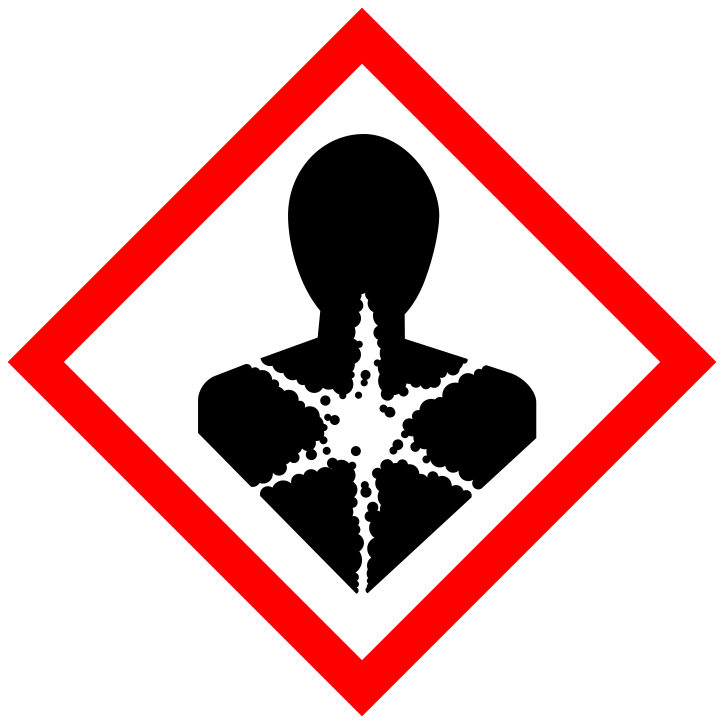
Zararlar
Faydalar
İşlevler
Nerede bulunur?
Fonksiyon ve Kullanım
Dengeleyici
Düzenleyici not
Avrupa Komisyonu bu maddeyi, (EC) 1223/2009 sayılı Yönetmeliğin Ek III'ünde (kozmestik ürünlerin belirtilen kısıtlamalara tabi olmak kaydıyla içermemesi gereken maddeler) 14 numaralı referans altında listeler. Konsantrasyon limitleri ve kullanım koşulları geçerlidir. Tanımlayıcılar: CAS 123-31-9, EC 204-617-8. Ek sütunlarında listelenen ürün türleri ve maksimum konsantrasyonlar: Yapay tırnak sistemleri — kullanıma hazır karışımda %0,02'ye kadar.
- EU 1223/2009 Annex IIYasak
- EU 1223/2009 Annex IIIKısıtlı
Maksimum konsantrasyon: 0.02%
Sanayi GHS bildirimleri (PubChem)
Bunlar ECHA’ya sanayi beyanlarıdır; bizim düzenleyici değerlendirmemiz değildir.
- H302(99.7%)- Yutulması hâlinde zararlı
- H312(17.7%)- Cilt ile teması hâlinde zararlı
- H315- Cilt tahrişine yol açar
- H316- H316
- H317- Alerjik cilt reaksiyonlarına yol açabilir
- H318(99.9%)- Ciddi göz hasarına yol açar
- H319- Ciddi göz tahrişine yol açar
- H336- Rehavet veya baş dönmesine yol açabilir
- H340- Genetik hasara yol açabilir
- H341(99.9%)- Genetik hasara yol açma şüphesi var
- H351- Kansere yol açma şüphesi var
- H360- Doğmamış çocukta hasara ya da üreme yeteneğinde bozulmaya yol açabilir
- H370- Organlarda hasara yol açar
- H400- Sucul ortamda çok toksik
- H410(21.2%)- Sucul ortamda uzun süre kalıcı, çok toksik
Kaynaklar Ne Diyor
SCCS (AB Tüketici Güvenliği Bilimsel Komitesi)6
EU 1223/2009 Annex III — SCCS görüşü: Opinion on The Use of Benzoyl Peroxide (BPO)
EU 1223/2009 Annex III — SCCS görüşü: Hydroquinone (HQ)
EU 1223/2009 Annex III — SCCS görüşü: Hydroquinone methylether (MEHQ) in artificial nail systems
EU 1223/2009 Annex III — SCCS görüşü: Opinion concerning Hydroquinone (1
EU 1223/2009 Annex III — SCCS görüşü: 4-Dihydroxybenzene) as a Hair Dye Constituent
+1 kayıt daha.
CIR (Kozmetik Madde İnceleme Paneli)15
Analytical Methods The purity of Hydroquinone, derivatized and underivatized samples, has been determined using gas chromatography with a flame ionization detector (GUFID) JAm Co11 Toxicol, Vol. 13, No. 3, 1994 II Distributed for Comment Only -- Do Not Cite or Quote H YDROQUINONE 169 (Eastman Kodak Company, 1988, 1989). The structure of Hydroquinone was confirmed by gas chromatography-mass spectrometry (GUMS), using electron impact ionization (EI). Rate of Hydroquinone Disappearance During Its Use in Hair Dyes Hydroquinone, which acts as a regulating agent allowing some control of the color-forming coupling reactions, is a “consumable” in the hair dyeing procedure, with its actual concentration decreasing as the color-forming reactions proceed (L’Oreal, 1990). To determine how much of the Hydroquinone is consumed, three commercial hair dye formulations were used to measure the rate of disappearance of Hydro- quinone during the hair dyeing procedure (L’Oreal, 1990). Two of the formula- tions contained 0.08% (w/w) and the third contained 0.15% (w/w) Hydroquinone. An oxidation cream containing 6% (w/w) hydrogen peroxide was used for oxida- tion of the mixtures. The test article was prepared by mixing 15 g of the cream oxidant with 15 g of the hair dye. It was then uniformly applied with a paintbrush to a 30 cm long (15 g) lock of natural hair. After 5, 10, 20, and 30 min, 2.5 g samples of the hair dye mixture were collected from the hair lock and assayed in a high-performance liquid chromatography (HPLC) system. (Results of the system calibration showed that it responded linearly with respect to concentration of Hydroquinone for the range 0.8-80 Fg/ml.) For each of the three formulations, the percentage of residual Hydroquinone was determined as a function of time. The amount of Hydroquinone that remained … [kırpıldı — bölüm toplam 214341 karakter]
Repeated Dose Toxicity Dermal – Non-Human Hydroquinone (2% in a topical cream) caused liver and kidney damage when administered to rabbits (n = 6) for 6 weeks.21 The test substance was administered daily to one or both ears of the rabbits or to the shaved abdomen; the rabbits were killed and necropsied. Findings in the liver included hydropic degeneration, bile duct hyperplasia, and glycogen depletion. Hydropic degeneration, hyaline casts, congestion, perivascular edema, and fibrosis were observed in the kidneys. For both the kidneys and livers, the effects were greater in the groups in which the test substance was administered to the ears. Dermal effects included hyperkeratosis, lymphocytic and eosinophilic infiltration, and congestion of dermal blood vessels. Dermal depigmentation was observed when hydroquinone (5% in propylene glycol/ethanol, 50:50) or p- hydroxyanisole (5% in propylene glycol/ethanol, 50:50) was dermally administered to multiple sites of the backs of Yucatan miniature pigs (n = 2) twice/day, 7 days/week for 90 days.22 Microscopic examination of biopsies from the test area showed decreased pigment and melanocytes. GENOTOXICITY In Vitro HYDROQUINONE Hydroquinone (0, 10, 20, 30, 40 µM) did not induce DNA damage to human L-02 liver cells but was genotoxic to the same cell line with silenced DNA polymerase eta (η) after 24 h of incubation.23 DNA damage was determined by means of the Comet assay, apoptosis and cell cycle distribution were determined using flow cytometry, the mRNA expression levels of Polη were determined by real-time PCR, the protein expression levels of Polη and γ-H2AX were determined by Western blot, and γ-H2AX foci were visualized by confocal laser scanning fluorescence microscopy after cells were exposed to … [kırpıldı — bölüm toplam 13041 karakter]
Definition and Structure Hydroquinone (CAS No, 123-31-9) is defined in the International Cosmetic Ingredient Dictionary and Handbook as the aromatic organic compound that conforms to the formula in Figure 1.9 It is currently reported to function in cosmetics as an antioxidant, fragrance ingredient, hair colorant, reducing agent, and skin bleaching agent. Hydroquinone is a common name for 1,4-dihydroxybenzene. Hydroquinone is a substituted phenol (Figure 1). This aromatic diol is a white to off-white crystalline material. As noted in the year 2010 report on this ingredient, hydroquinone is most commonly produced through hydroperoxidation of p-diisopropylbenzene, hydroxylation of phenol, or oxidation of aniline.3 OH HO Hydroquinone Figure 1. Hydroquinone. USE Cosmetic Hydroquinone, alone or in combination with p-hydroxyanisole, is used as a stabilizer that inhibits the polymerization in the liquid component of 2-component methacrylate artificial nail systems.10 The maximum concentration of hydroquinone alone, or in combination with p-hydroxyanisole, is reported to be 200 ppm (0.02%). After mixing 2 parts liquid to 1 part powder in preparation for use, the final concentration of hydroquinone, or hydroquinone and p-hydroxyanisole combined is approximately 133 ppm (0.0133%). When used as a nail adhesive, a brush is wetted in the liquid component which contains the stabilizer(s) and acrylate monomers. The wetted brush is then dipped into the powder which contains the initiator to produce an 'aspirin sized' bead. … [kırpıldı — bölüm toplam 7079 karakter]
Repeated Dose Toxicity Dermal – Non-Human Hydroquinone (2% in a topical cream) caused liver and kidney damage when administered to rabbits (n=6) for 6 weeks.22 The test substance was administered daily to 1 or both ears (volume not specified) of the rabbits or to the shaved abdomen (2 g/cm2); the rabbits were killed and necropsied. Findings in the liver included hydropic degeneration, bile duct hyperplasia, and glycogen depletion. Hydropic degeneration, hyaline casts, congestion, perivascular edema, and fibrosis were observed in the kidneys. For both the kidneys and livers, the effects were greater in the groups in which the test substance was administered to the ears. Dermal effects included hyperkeratosis, lymphocytic and eosinophilic infiltration, and congestion of dermal blood vessels. Dermal depigmentation was observed when hydroquinone (5% in 25 µL propylene glycol/ethanol, 50:50) was dermally administered to multiple sites of the backs of Yucatan miniature pigs (n=2) twice/day, 7 days/week for 90 days.23 Microscopic examination of biopsies from the test area showed decreased pigment and melanocytes. Cytotoxicity Hydroquinone (0, 10, 20, 30, 40 µM) was not cytotoxic to human L-02 liver cells but was cytotoxic to the same cell line with silenced DNA polymerase eta (Polη) after 24 h of incubation.24 Cell survival was determined using the MTT assay. Hydroquinone (500, 750 µM) was cytotoxic, in a concentration-dependent manner, to F344 rat hepatocytes when incubated for 2 h.25 Hydroquinone was cytotoxic to human lymphocytes at 270 μM, but not at 180 μM, when incubated for 3, 24, or 48 h with metabolic activation and 3 h without metabolic activation.26 GENOTOXICITY In Vitro … [kırpıldı — bölüm toplam 19694 karakter]
Definition and Structure Hydroquinone (CAS No, 123-31-9) is defined in the International Cosmetic Ingredient Dictionary and Handbook as the aromatic organic compound that conforms to the formula in Figure 1.9 It is currently reported to function as an antioxidant, fragrance ingredient, hair colorant, reducing agent, and skin bleaching agent. Hydroquinone is a common name for 1,4-dihydroxybenzene. Hydroquinone is a substituted phenol (Figure 1). This aromatic diol is a white to off-white crystalline material. As noted in the year 2010 report on this ingredient, hydroquinone is most commonly produced through hydroperoxidation of p-diisopropylbenzene, hydroxylation of phenol, or oxidation of aniline.3 OH HO Hydroquinone Figure 1. Hydroquinone. USE Cosmetic Use in Nail Products Hydroquinone, alone or in combination with p-hydroxyanisole, is used as a stabilizer that inhibits the polymerization in the liquid component of two-component methacrylate artificial nail systems.10 The maximum concentration of hydroquinone alone, or in combination with p-hydroxyanisole, is reported to be 200 ppm (0.02%). After mixing 2 parts liquid to 1 part powder in preparation for use, the final concentration of hydroquinone, or hydroquinone and p-hydroxyanisole combined is approximately 133 ppm (0.0133%). When used as a nail adhesive, a brush is wetted in the liquid component which contains the stabilizer(s) and acrylate monomers. The wetted brush is then dipped into the powder which contains the initiator to produce an 'aspirin sized' bead. … [kırpıldı — bölüm toplam 6947 karakter]
+10 kayıt daha.
IARC (Uluslararası Kanser Araştırmaları Ajansı)1
IARC Grup 3 — Kanserojenliği sınıflandırılamıyor. Mevcut kanıt bir sınıflandırma yapmaya yetmiyor. 'Güvenli' DEMEK DEĞİLDİR; 'yeterli veri yok' demektir. (Monograf cilt: 15, Sup 7, 71). Sınır: IARC TEHLİKE sınıflandırması yapar, RİSK değil — 'bir koşulda kansere yol açabilir' der, 'kozmetikteki kullanım seviyesinde kanser yapar' DEMEZ. Maruziyet yolu ve dozu ayrıca değerlendirilmelidir. Veri 01/2021 anlık görüntüsüdür.
ToxValDB (EPA Toksisite Değerleri Veri Tabanı)16
EPA ToxValDB cilt/göz verisi — endpoint: Skin Sensitization, sınıflandırma: Sh. Sınır: bu bir derleme kayıttır; doz, tür ve maruziyet yolu birlikte değerlendirilmelidir.
EPA ToxValDB cilt/göz verisi — endpoint: Skin Sensitization, sınıflandırma: Skin Sens. 1. Sınır: bu bir derleme kayıttır; doz, tür ve maruziyet yolu birlikte değerlendirilmelidir.
EPA ToxValDB cilt/göz verisi — endpoint: Eye Irritation, sınıflandırma: Eye Dam. 1. Sınır: bu bir derleme kayıttır; doz, tür ve maruziyet yolu birlikte değerlendirilmelidir.
EPA ToxValDB cilt/göz verisi — endpoint: Eye Irritation, sınıflandırma: Serious eye damage/eye irritation - Category 2. Sınır: bu bir derleme kayıttır; doz, tür ve maruziyet yolu birlikte değerlendirilmelidir.
EPA ToxValDB cilt/göz verisi — endpoint: Skin Irritation, sınıflandırma: Not classified. Sınır: bu bir derleme kayıttır; doz, tür ve maruziyet yolu birlikte değerlendirilmelidir.
+11 kayıt daha.
EPA ToxCast (yüksek hacimli in vitro tarama)1
EPA ToxCast ER modeli: östrojen reseptörü aktivitesi BULUNMADI (AUC agonist=0, antagonist=0). 18 in vitro deneyde test edildi. Sınır: in vitro tarama modelidir, doz/maruziyet bağlamı içermez; kozmetikteki kullanım seviyesinde insanda etki gösterdiği anlamına GELMEZ.
Bilimsel Referanslar
- 4-Dihydroxybenzene) as a Hair Dye ConstituentSCCS — Scientific Committee on Consumer Safety
- CIR - Amended Safety Assessment ofCosmetic Ingredient Review (CIR), Personal Care Products Council(2013)
- EPA CompTox Chemicals Dashboard - DSSTox identifiers mapped to CAS (2021r1)US EPA, Center for Computational Toxicology and Exposure
- EPA ToxCast/Tox21 - endocrine pathway screening (ER CERAPP, AR)US EPA, Center for Computational Toxicology and Exposure
- EU CosIng - Cosmetic Ingredient Database full exportEuropean Commission, DG GROW
- Foreseeable use of hair dyesSCCS — Scientific Committee on Consumer Safety
- Hydroquinone (HQ)SCCS — Scientific Committee on Consumer Safety
- Hydroquinone methylether (MEHQ) in artificial nail systemsSCCS — Scientific Committee on Consumer Safety
- IARC Monografları - Hydroquinone (Grup 3 - Kanserojenliği sınıflandırılamıyor)IARC — WHO Uluslararası Kanser Araştırmaları Ajansı
- Opinion concerning Hydroquinone (1SCCS — Scientific Committee on Consumer Safety
- Opinion on The Use of Benzoyl Peroxide (BPO)SCCS — Scientific Committee on Consumer Safety
- PubChem - CID-Synonym-filtered bulk + PUG REST propertiesNCBI / National Library of Medicine
- ToxCast ER modeli - Hydroquinone (DTXSID7020716)US EPA — ToxCast / CompTox
- ToxValDB - cilt/gözUS EPA — ToxValDB v97
- ToxValDB - genotoksisiteUS EPA — ToxValDB v97
- ToxValDB - kanserUS EPA — ToxValDB v97