
Butoksietanol
Butoxyethanol
- CAS
- 111-76-2
- EC
- 2039050
- PubChem CID
- 8133
- Moleküler Formül
- C6H14O2
- Moleküler Ağırlık
- 118.1700 g/mol
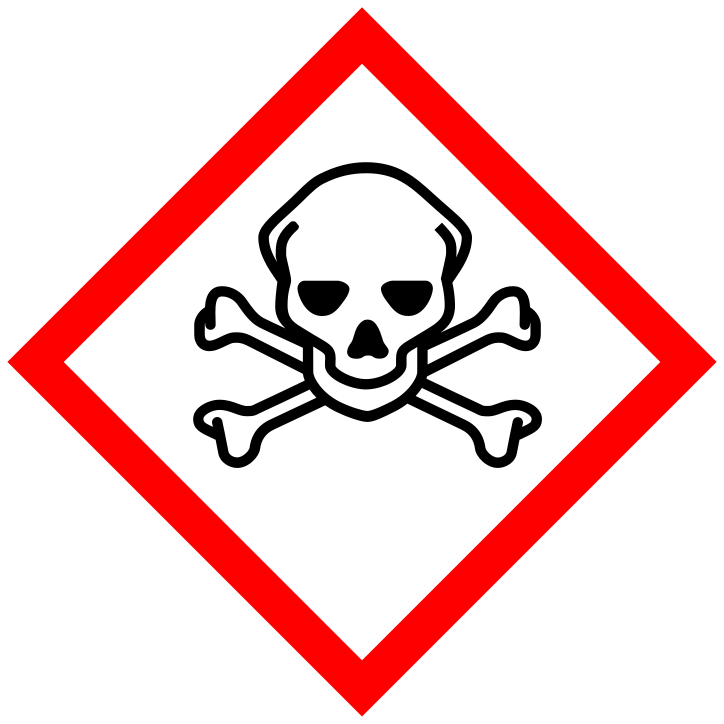
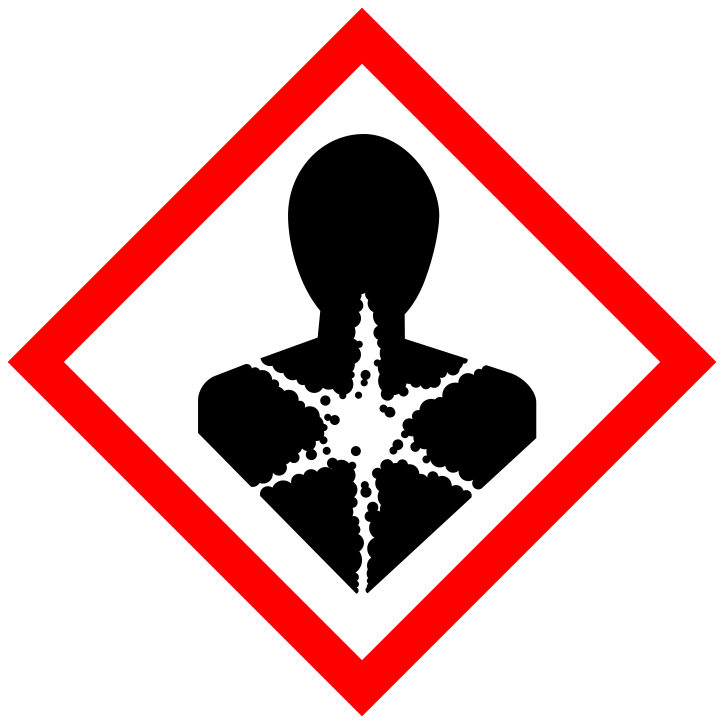
Saç boyalarında boyayı çözen sert bir kimyasal çözücü. Kanserojen ve solunum sistemi için toksik.
Ne işe yarar?
Saç boyası ürünlerinde çözücü olarak kullanılır.
Ayrıntı
Boyaların içinde bulunan pigmentleri ve yağları birbirine karıştırarak homojen bir formülün oluşmasını sağlayan butoksietananol, saç boyalarına karakteristik kokusunu da veriyor. Bu madde temasla ve solunmayla vücuda girip karaciğer ve böbrekler üzerinde ciddi zararlara yol açabiliyor; ayrıca kanserojen etkiye sahip olabileceğine dair çalışmalar mevcut. Hamileler ve küçük çocuklar için riskli, bu yüzden kullanırken iyi havalandırılmış yerlerde olmaya özen göstermek gerekiyor.
Faydalar
İşlevler
Nerede bulunur?
Ayrıca bilinir
Fonksiyon ve Kullanım
Kıvam Düzenleyici
Koku Kapatıcı
Çözücü
Düzenleyici not
Avrupa Komisyonu, bu maddeyi 1223/2009 sayılı AB Kozmetik Ürünleri Yönetmeliği'nin Ek III'ünde (belirtilen sınırlamalara tabi olarak kozmetik ürünlerde bulunmaması gereken maddeler) referans numarası 188 altında listelemiştir. Konsantrasyon limitleri ve kullanım koşulları geçerlidir. Tanımlayıcılar: CAS 111-76-2, EC 203-905-0. Ek sütunlarında belirtilen ürün türleri ve maksimum konsantrasyonlar: (a) Oksidatif saç boyası ürünlerinde çözücü — %4,0'a kadar; (b) Oksidatif olmayan saç boyası ürünlerinde çözücü — %2,0'a kadar.
- EU 1223/2009 Annex IIIKısıtlı
Sanayi GHS bildirimleri (PubChem)
Bunlar ECHA’ya sanayi beyanlarıdır; bizim düzenleyici değerlendirmemiz değildir.
- H227- Alevlenebilir sıvı
- H302(99.5%)- Yutulması hâlinde zararlı
- H310- Cilt ile teması hâlinde öldürücü
- H311- Cilt ile teması hâlinde toksik
- H312(79.9%)- Cilt ile teması hâlinde zararlı
- H315(99.6%)- Cilt tahrişine yol açar
- H318(38.9%)- Ciddi göz hasarına yol açar
- H319(99.5%)- Ciddi göz tahrişine yol açar
- H330- Solunması hâlinde öldürücü
- H331(11.7%)- Solunması hâlinde toksik
- H332(83.6%)- Solunması hâlinde zararlı
- H335- Solunum yolu tahrişine yol açabilir
- H336- Rehavet veya baş dönmesine yol açabilir
- H361- Doğmamış çocukta hasara ya da üreme yeteneğinde bozulmaya yol açma şüphesi var
- H370- Organlarda hasara yol açar
Kaynaklar Ne Diyor
SCCS (AB Tüketici Güvenliği Bilimsel Komitesi)1
EU 1223/2009 Annex III — SCCS görüşü: Opinion on Ethylene Glycol Monobutyl Ether (EGBE) - Butoxyethanol (INCI)
CIR (Kozmetik Madde İnceleme Paneli)28
Butoxyethanol was, at most, moderately irritating to rabbit skin.2 In a human repeated insult patch test (HRIPT) involving 201 healthy subjects, 10% Butoxyethanol was not a sensitizer. Definite erythema and barely perceptible erythema were observed in 1 and 13 subjects, respectively, during the challenge phase. Reactions ranging from barely perceptible to definite erythema were observed in 63 subjects during induction. Irritation Animal In a study using 5 New Zealand White rabbits, undiluted Butoxyethanol (0.5 ml) was applied under occlusion to an area of 6 cm2 on shaved skin for 4 h.4 The application site was then rinsed. Slight to moderate erythema and very slight edema were observed. The effects were persistent and still very slightly visible at the end of the 14-d observation period. The mean erythema score was 1.7 out of 4 and the mean edema score was 0. In another irritation study, 6 albino rabbits received undiluted Butoxyethanol (0.5 ml) under occlusive conditions to an area of 2.54 cm2 for 24 h.4,5 Test sites were not rinsed. Very slight edema and erythema were observed at the 72-h observation period. The mean primary dermal irritation index was 1.5 out of 8. Sensitization Animal The sensitization potential of Butoxyethanol was assessed in a guinea pig maximization study in accordance with Organisation for Economic Co-operation and Development (OECD) test guideline (TG) 406.4,5 Ten Dunkin-Hartley guinea pigs were used in the study. During the induction phase, 0.5% Butoxyethanol in 0.9% was injected intradermally and 25% Butoxyethanol in saline was applied topically under occlusion (2 x 4 cm2 area) for 48 h. After an ~2-wk rest, the challenge phase was performed topically under occlusion (8 mm diameter patch) for 24 h with 10% Butoxyethanol in saline. A … [kırpıldı — bölüm toplam 2202 karakter]
In dermal carcinogenicity studies with rats, a hair dye containing Butoxyethanol (10%) was not carcinogenic, but a rust-preventive product containing Butoxyethanol (2.5%) was carcinogenic.2 It should be noted that the latter product contained 90.9% Stoddard solvent (a refined petroleum distillate). In 2000, the NTP published the results of 2-yr inhalation studies of Butoxyethanol in male and female B6C3F1 mice and male and female F344/N rats.23 The mice were exposed to 0, 62.5, 125, or 250 ppm for 6 h/d, 5 d/wk, for 104 wk, and the rats were exposed to 0, 31.2, 62.5, or 125 ppm for the same time period. In male mice of the 250 ppm group, increased incidences of hemagiosarcoma of the liver, a marginal increase in the incidences of forestomach squamous cell papilloma, and an increase in the incidences of hepatocellular carcinoma were observed. In female mice of the 250 ppm, increased incidences of forestomach squamous cell papilloma or carcinoma (mainly papilloma) were observed. Increased incidences of forestomach neoplasms in the mice occurred in groups in which ulceration and hyperplasia were also present. No evidence of carcinogenic activity from exposure to Butoxyethanol was observed in male rats; however, there was equivocal evidence of carcinogenic activity in female rats exposed to 125 ppm Butoxyethanol based on the increased combined incidences of benign or malignant pheochromocytoma (mainly benign) of the adrenal medulla. In both species of animals, exposure to Butoxyethanol caused a mild regenerative anemia and effects secondary to the anemia. Overall, the International Agency for Research on Cancer (IARC) determined that Butoxyethanol is not classifiable as to its carcinogenicity to humans (Group 3).24 In the evaluation, there was inadequate evidence in and limited evidence in experimental animals for carcinogenicity of Butoxyethanol. The US Environmental Protection Agency (EPA) integrated risk … [kırpıldı — bölüm toplam 13993 karakter]
Case Reports A 53-yr-old male patient accidentally co-ingested ethanol and 150 - 250 ml of pure Butoxyethanol.37 The patient developed rapid obtundation, severe airway edema, hypotension, and prolonged acidosis. The patient recovered without sequelae. Occupational Exposure The application of an ink wash solvent, diluted to a concentration of 0.5 - 2.5% Butoxyethanol, did not induce sensitization or photosensitization reactions in 5 workers who had been exposed to Butoxyethanol in the workplace.2 Screening was performed in 34 screen-printing workers exposed to Butoxyethanol and in 37 non-exposed clerical workers.38 The exposed group of workers usually worked 8 h/d for 5 d/wk. A Chi-square test showed the reticulocyte percentages and corrected reticulocyte counts to be significantly higher in the exposed group. T-tests showed a significant increase in white blood cell counts, reticulocyte percentages, and corrected reticulocyte count (i.e., reticulocyte index) in the exposed group, with p-values of 0.002, 0.004, and 0.002, respectively. Multivariate analysis showed the odds ratio for the corrected reticulocyte counts to be 16.30 for the exposed group, when compared with that of the control group. Firefighter exposure to ingredients in firefighting foam, including Butoxyethanol, was assessed by biomonitoring methods during 3 consecutive firefighting training sessions.39 The firefighters’ short-term exposure to Butoxyethanol was analyzed by urinalysis of 2-butoxyacetic acid. In 2 of the training sessions, the average urinary excretions of 2-butoxyacetic acid (1.4 mmol/mol creatinine) exceeded the reference limit of the occupationally unexposed population (0.5 mmol/mol creatinine). In the third session, the average urinary excretion of 2-butoxyacetic acid was 0.8 mmol/mol creatinine. … [kırpıldı — bölüm toplam 4242 karakter]
Undiluted butoxyethanol was an ocular irritant in rabbits.2 Additional testing in rabbits found Butoxyethanol at 5% caused no corneal injury, while 15% Butoxyethanol caused moderate corneal injury. Additional ocular irritation data are summarized in Table 7. Butoxyethanol tested undiluted and in 10% solution was irritating in a hen’s eye test-chorioallantoic membrane (HET-CAM) assay and a corneal swelling test.4 In several in vivo rabbit studies, undiluted Butoxyethanol was irritating to eyes.4,5
Definition and Structure According to the Dictionary, Butoxyethanol (CAS No. 111-76-2) is the ether alcohol that conforms to the structure depicted in Figure 1.1 Figure 1. Butoxyethanol Chemical Properties Chemical properties for Butoxyethanol are summarized in Table 1. Butoxyethanol is a colorless liquid with a molecular weight of 118.18 g/mol.2 The log Pow at 25ºC is 0.81.4 Method of Manufacture Butoxyethanol is usually prepared by the reaction of ethylene oxide with butyl alcohol and may also be prepared by the direct alkylation of ethylene glycol with an agent such as dibutyl sulfate. 2 Another method for the production of Butoxyethanol is the reaction of butyl alcohol with ethylene carbonate or 2-chloroethanol. Butoxyethanol may also be produced through reacting ethylene glycol with butyl bromide. Composition and Impurities Water accounts for not more than 0.2% of the composition of Butoxyethanol.2 The purity of technical-grade Butoxyethanol ranges from 98 - 99.5%. Commercial samples of glycol ethers invariably contain small quantities of peroxides. A supplier reported impurities as follows: acidity (0.001 mEq/g), carbonyl (210 - 276 ppm), peroxide (66 - 169 ppm), dioxane (0.35 ppm), ethylene oxide (0.015 ppm), ethylene glycol (0.32%), butanol (420 - 450 ppm), butyraldehyde (210 - 330 ppm), diethylene glycol (100 ppm), butyl carbitol (< 100 ppm), and “heavies” (0.1%). The SCCP reported that Butoxyethanol is > 99% pure.5 Impurities are as follows: 2-butoxyethoxyethanol (< 0.3% w/w), 1,2-ethanediol (< 0.5% w/w), 1-butanol (< 0.2% w/w), and water (< 0.2% w/w). Butylated hydroxytoluene (0.008 - 0.012% w/w) may be added to prevent the formation of peroxides. Distributed for Comment Only -- Do Not Cite or Quote … [kırpıldı — bölüm toplam 9138 karakter]
+23 kayıt daha.
IARC (Uluslararası Kanser Araştırmaları Ajansı)1
IARC Grup 3 — Kanserojenliği sınıflandırılamıyor. Mevcut kanıt bir sınıflandırma yapmaya yetmiyor. 'Güvenli' DEMEK DEĞİLDİR; 'yeterli veri yok' demektir. (Monograf cilt: 88). Sınır: IARC TEHLİKE sınıflandırması yapar, RİSK değil — 'bir koşulda kansere yol açabilir' der, 'kozmetikteki kullanım seviyesinde kanser yapar' DEMEZ. Maruziyet yolu ve dozu ayrıca değerlendirilmelidir. Veri 01/2021 anlık görüntüsüdür.
ToxValDB (EPA Toksisite Değerleri Veri Tabanı)15
EPA ToxValDB cilt/göz verisi — endpoint: Eye Irritation, sınıflandırma: Serious eye damage/eye irritation - Category 2. Sınır: bu bir derleme kayıttır; doz, tür ve maruziyet yolu birlikte değerlendirilmelidir.
EPA ToxValDB cilt/göz verisi — endpoint: Skin Irritation, sınıflandırma: Skin corrosion/irritation - Category 2. Sınır: bu bir derleme kayıttır; doz, tür ve maruziyet yolu birlikte değerlendirilmelidir.
EPA ToxValDB cilt/göz verisi — endpoint: Skin Sensitization, sınıflandırma: Not classified. Sınır: bu bir derleme kayıttır; doz, tür ve maruziyet yolu birlikte değerlendirilmelidir.
EPA ToxValDB cilt/göz verisi — endpoint: Eye Irritation, sınıflandırma: Category 6.4A (Category 2A). Sınır: bu bir derleme kayıttır; doz, tür ve maruziyet yolu birlikte değerlendirilmelidir.
EPA ToxValDB cilt/göz verisi — endpoint: Skin Irritation, sınıflandırma: Category 6.3B (Category 3). Sınır: bu bir derleme kayıttır; doz, tür ve maruziyet yolu birlikte değerlendirilmelidir.
+10 kayıt daha.
EPA ToxCast (yüksek hacimli in vitro tarama)1
EPA ToxCast ER modeli: östrojen reseptörü aktivitesi BULUNMADI (AUC agonist=0, antagonist=0). 18 in vitro deneyde test edildi. Sınır: in vitro tarama modelidir, doz/maruziyet bağlamı içermez; kozmetikteki kullanım seviyesinde insanda etki gösterdiği anlamına GELMEZ.
Bilimsel Referanslar
- CIR - Amended Safety Assessment of ButoxyethanolCosmetic Ingredient Review (CIR), Personal Care Products Council(2025)
- EPA CompTox Chemicals Dashboard - DSSTox identifiers mapped to CAS (2021r1)US EPA, Center for Computational Toxicology and Exposure
- EU CosIng - Cosmetic Ingredient Database full exportEuropean Commission, DG GROW
- IARC Monografları - 2-Butoxyethanol (Grup 3 - Kanserojenliği sınıflandırılamıyor)IARC — WHO Uluslararası Kanser Araştırmaları Ajansı
- Opinion on Ethylene Glycol Monobutyl Ether (EGBE) - Butoxyethanol (INCI)SCCS — Scientific Committee on Consumer Safety
- ToxCast ER modeli - 2-Butoxyethanol (DTXSID1024097)US EPA — ToxCast / CompTox
- ToxValDB - cilt/gözUS EPA — ToxValDB v97
- ToxValDB - genotoksisiteUS EPA — ToxValDB v97
- ToxValDB - kanserUS EPA — ToxValDB v97